

Jordan Ticehurst
Jordan Ticehurst is a Service Engineering Manager at an Optronics service centre and a Bachelor of Engineering (Honours) student in Robotics and Mechatronics at Western Sydney University. With nearly a decade of experience supporting complex electro-optical systems, he specialises in fault diagnosis, maintenance planning and continuous improvement. Jordan started as a toolmaker and has progressively moved into technical leadership roles, coordinating repair workflows, designing test benches, training technicians and working closely with customers. He is passionate about practical engineering that blends hands-on problem solving with data-driven decision making. After graduating, he aims to move into technical robotics/mechatronics design roles.

Jordan Ticehurst

PROJECT OVERVIEW
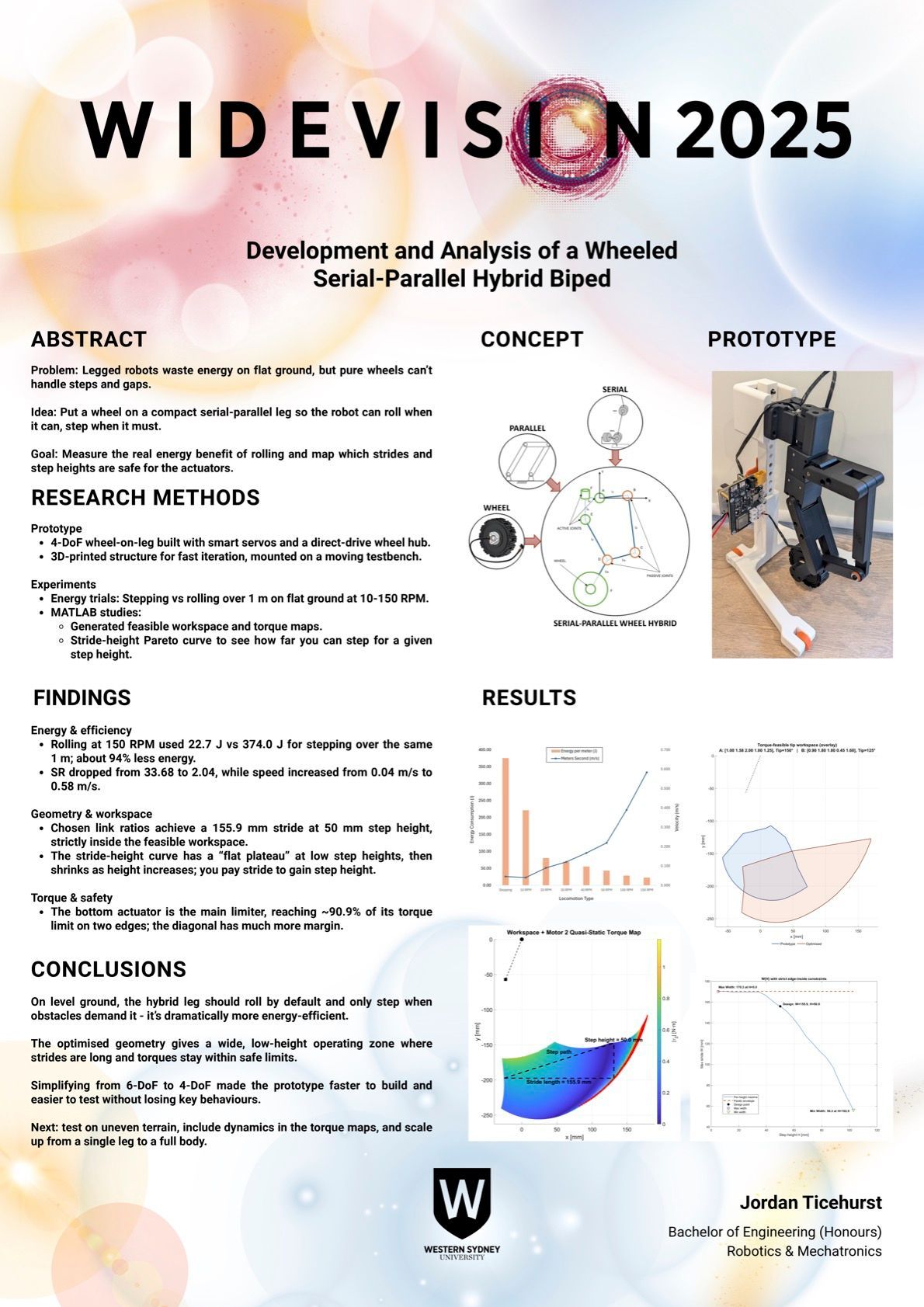


Legged robots are good at climbing over obstacles, while wheeled robots are fast and efficient on flat ground. This thesis asks: can a single “wheeled-leg” get the best of both, without wasting energy or overloading its motors? The project develops and tests a wheeled serial-parallel hybrid biped leg - a lightweight 3D-printed prototype with a drive wheel at the tip and two actuated joints. Experimentally, the leg is driven over repeated one-metre traverses, first stepping and then rolling at different wheel speeds. Current is measured through a precision shunt and converted into energy use and specific resistance, a standard robotics metric that compares energy per metre to the robot’s weight. On the modelling side, custom MATLAB tools map all tip positions the leg can reach while keeping motor torques within safe limits. These “torque-feasible workspaces” are then searched for stride and step-height combinations that are both reachable and mechanically realistic. The results show that, on level terrain, rolling is dramatically more efficient than stepping: at the highest tested wheel speed, traverse energy drops from roughly 374 J to 23 J and specific resistance falls by about 94%. The workspace studies identify a geometry that offers around a 160 mm stride and 50 mm step height while staying within motor limits, and highlight which postures come closest to overloading the actuators. Together, the prototype trials and simulations demonstrate that careful leg-wheel geometry and operating strategy can turn a simple hybrid leg into a highly energy-efficient mobility option for future small robots.


Jordan Ticehurst