

Paul Borg
What appeals to me about engineering is the diversity that it covers. Projects range from refining original principles with the integration of technology as well as breakthroughs that have not been achieved before. The continuous nature of research means progress will never cease as new challenges emerge, which I hope to successfully contribute to.

Paul Borg

PROJECT OVERVIEW
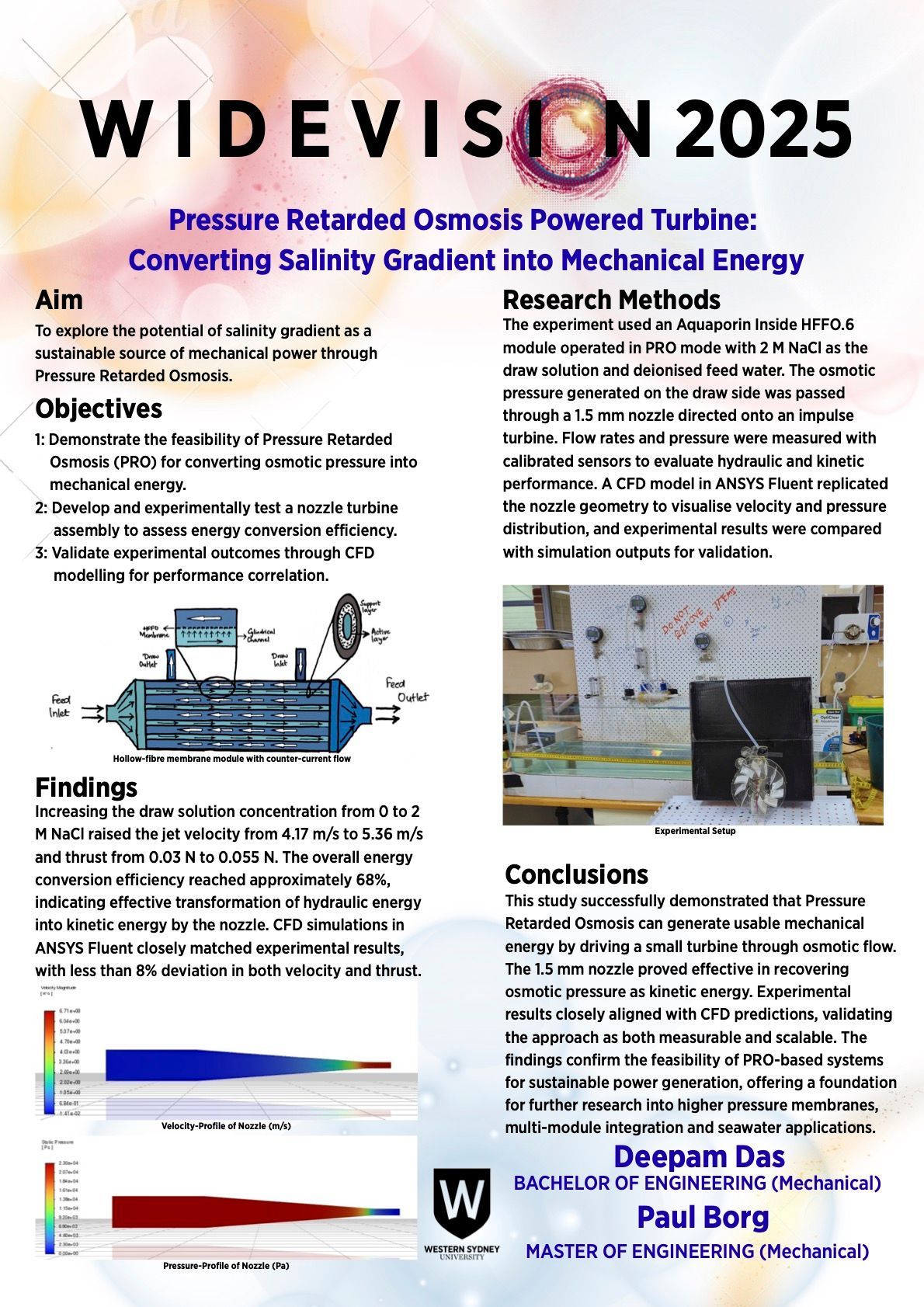


With the demanding nature of modern life, being thoroughly integrated with technology, energy is a resource that is being extensively. With electrification of assets such as transport and evolution from mechanical systems now being smart, being able to supply such demands sustainably is a current challenge. With the proposed phase out of fossil fuelled power stations cleaner technologies are being developed for this transition. Established technologies that are currently available include Solar, Wind and Hydro-electric systems. The reliability of these technologies, due to being climate-dependant governs their ability to be a consistent source of power supply. Finding a method of producing power that uses natural means of generating power, yet not heavily impacted by environmental factors as well as being considerate of triple bottom line items. One such principle that shows promise of such prospects is the process of osmotic power. This system captures the chemical potential between two streams of water with differing chemical concentrations that influences a passive transfer of matter through a semi permeable membrane. The attraction of the low concentration fluid to the higher dissolved fluid body is the basic principle of osmosis. In nature such instances occur between sea water and freshwater in estuaries, with the difference of salinity. This idea of capturing energy from these sources was conceptualised by Sydney Loeb in the 1960’s. A pioneer in membrane technology, Loeb worked on reverse osmosis (RO) implementation and its ability to purify water for human consumption. Being inspired by the projects success, the researchers ambitions for forward osmosis (FO) success would inspire future innovators to assess the eligibility of the system. Projects steering from this seen the first prototype facility be made by a Danish power supplier ‘Statkraft’ in 2009. Using the adaption of Pressure Retarded Osmosis (PRO), the facility successfully generated electricity. But due to sourcing the fresh and salt water from natural sources, pre-filtration to protect the membranes as well as energy inputs to circulate the streams meant the plant was decommissioned in 2013. Other recent attempts including the Norway and Japan plants in 2023 and 2025, respectively seen more promising results. Through the research conducted in the current project in developing a refined module dimension, the hope for osmotic technology adoption is promising. Through our experimentation with Aquaporin membranes, the principles make headway in finding the optimal design.


Paul Borg