

Deepam Das
I am studying Mechanical Engineering at Western Sydney University with a strong interest in sustainable design and practical innovation. Through my work experience, I have gained hands on experience in hydraulic systems, HVAC design, and project commissioning. With a minor in construction economics, I approach engineering with both technical precision and a project focused mindset. I am the kind of person who’s curious about how things work and motivated to make them better. I am drawn to work that’s challenging, purposeful, and creates a lasting impact.

Deepam Das

PROJECT OVERVIEW
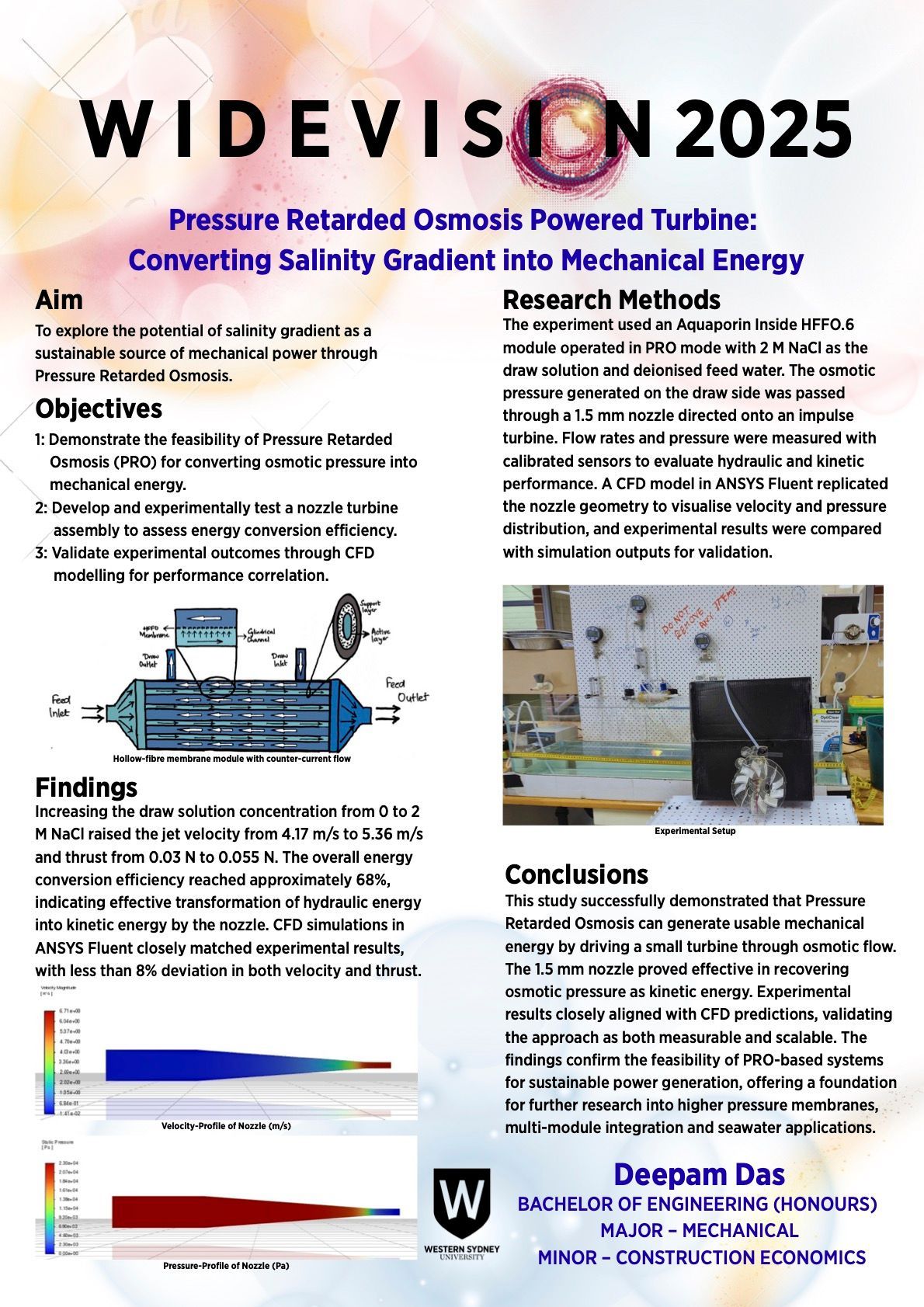


Pressure Retarded Osmosis Powered Turbine: Converting Salinity Gradient into Mechanical Energy This project demonstrates how energy can be harvested from the natural salinity difference between fresh water and seawater using Pressure Retarded Osmosis (PRO). The setup uses an Aquaporin Inside hollow-fibre forward osmosis membrane module, which allows water molecules to move selectively from the feed (low-salinity) side to the draw (high-salinity) side. The resulting osmotic flow builds hydraulic pressure, which is then released through a nozzle. The system operated Aquaporin HFFO.6 module in PRO mode with at a feed flow rate of 7 GPH (deionised water) and a draw flow rate of 7 GPH of 2 molar sodium chloride solution. Through osmotic transfer across the membrane, approximately 2 GPH of water permeated from the feed into the draw side, giving a total draw outlet flow of 9 GPH. This pressurised draw stream exited through a 1.5 mm nozzle, producing a jet velocity of 5.36 m/s and a thrust of 0.055 N in air. The jet was directed onto an impulse turbine, where the kinetic energy of the flow was converted into rotational motion. The measured hydraulic to kinetic efficiency reached 68%, confirming effective pressure to energy conversion within the nozzle. Computational Fluid Dynamics (CFD) analysis in ANSYS Fluent validated the experimental results, showing less than 8% deviation in jet velocity and thrust. This work highlights the connection between membrane science, fluid mechanics, and renewable energy conversion. It demonstrates how osmotic pressure can be transformed into usable mechanical power through membrane driven flow, representing a step toward sustainable energy systems inspired by natural salinity gradient.


Deepam Das