
Guiwen Sui
Guiwen(Wen) Sui completed Master of Environmental Engineering at Western Sydney University in 2025, following a Bachelor’s degree in China. With experience in wastewater design and GC–MS analysis, Wen developed strong technical and analytical skills during undergraduate research. During the Master’s program, Wen interned at MRA Consulting Group, contributing to a waste audit project for Pacific Island countries, and at Surgical Diagnostics Pty Ltd (SDx), conducting PFAS-related research and environmental data analysis. Wen aims to apply her expertise and passion to solving real-world environmental challenges.

Guiwen Sui

PROJECT OVERVIEW
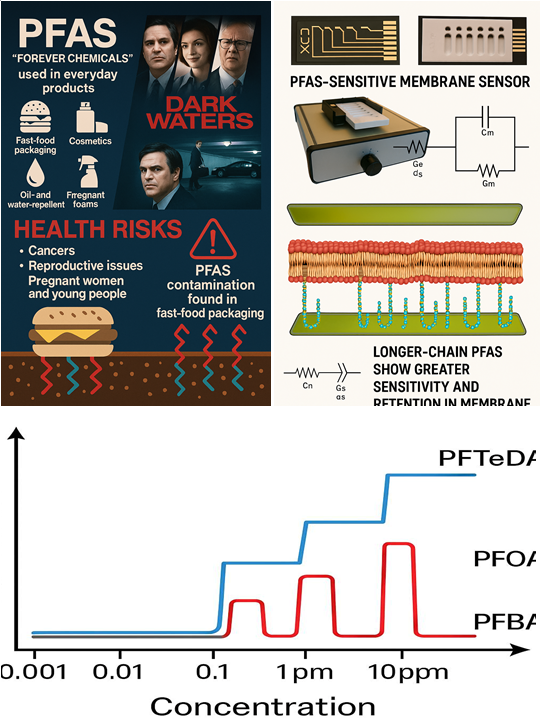


Project Pitch (Supervised by Dr. Mariam Darestani, in collaboration with Surgical Diagnostics Pty Ltd) PFAS, or “forever chemicals,” are used in everyday products from food packaging to cosmetics and firefighting foams due to their water- and oil-repellent properties. Our investigation found that common fast-food packaging, such as burger wrappers, often contains PFAS. These chemicals accumulate in the environment and can cause serious health risks, including cancers and reproductive issues, particularly for pregnant women and young people. With global regulations tightening, such as the US EPA’s stricter 2024 standards, understanding and monitoring PFAS is urgent. This project included extensive background research on PFAS’ properties, toxicity, industrial use, global regulations, and current sensors. Using Electrochemical Impedance Spectroscopy (EIS), we studied how PFAS of different chain lengths and functional groups affect lipid bilayers, models of cell membranes, revealing toxicity differences and possible mechanisms. We also developed a prototype PFAS-sensitive membrane sensor. The sensor exhibits different electrochemical responses depending on the chain length and functional group of PFAS, demonstrating the potential of membrane-based electrochemical sensors for efficient PFAS detection. This work improves understanding of PFAS toxicity and highlights promising approaches for practical, faster, and cost-effective environmental monitoring.


Guiwen SuiProject Pitch (Supervised by Dr. Mariam Darestani, in collaboration with Surgical Diagnostics Pty Ltd) PFAS, or “forever chemicals,” are used in everyday products from food packaging to cosmetics and firefighting foams due to their water- and oil-repellent properties. Our investigation found that common fast-food packaging, such as burger wrappers, often contains PFAS. These chemicals accumulate in the environment and can cause serious health risks, including cancers and reproductive issues, particularly for pregnant women and young people. With global regulations tightening, such as the US EPA’s stricter 2024 standards, understanding and monitoring PFAS is urgent. This project included extensive background research on PFAS’ properties, toxicity, industrial use, global regulations, and current sensors. Using Electrochemical Impedance Spectroscopy (EIS), we studied how PFAS of different chain lengths and functional groups affect lipid bilayers, models of cell membranes, revealing toxicity differences and possible mechanisms. We also developed a prototype PFAS-sensitive membrane sensor. The sensor exhibits different electrochemical responses depending on the chain length and functional group of PFAS, demonstrating the potential of membrane-based electrochemical sensors for efficient PFAS detection. This work improves understanding of PFAS toxicity and highlights promising approaches for practical, faster, and cost-effective environmental monitoring.