

Cristine Khay L. Nochefranca
Master of Environmental Engineering graduate (2023–2025) from Western Sydney University with Distinction and recipient of the Dean’s Merit List Award in 2023 and 2024. Experienced in sustainability and carbon monitoring at Legrand Australia and renewable energy and water reuse initiatives with Shell Philippines. Completed a Bachelor of Science in Chemical Engineering at De La Salle University – Manila, awarded the Outstanding Contribution to the Department Award. Undergraduate research focused on phosphorus recovery from septage sludge through struvite formation, and latest Master's research explores PFAS detection using electrochemical impedance spectroscopy with tethered bilayer lipid membrane systems.

Cristine Khay L. Nochefranca

PROJECT OVERVIEW
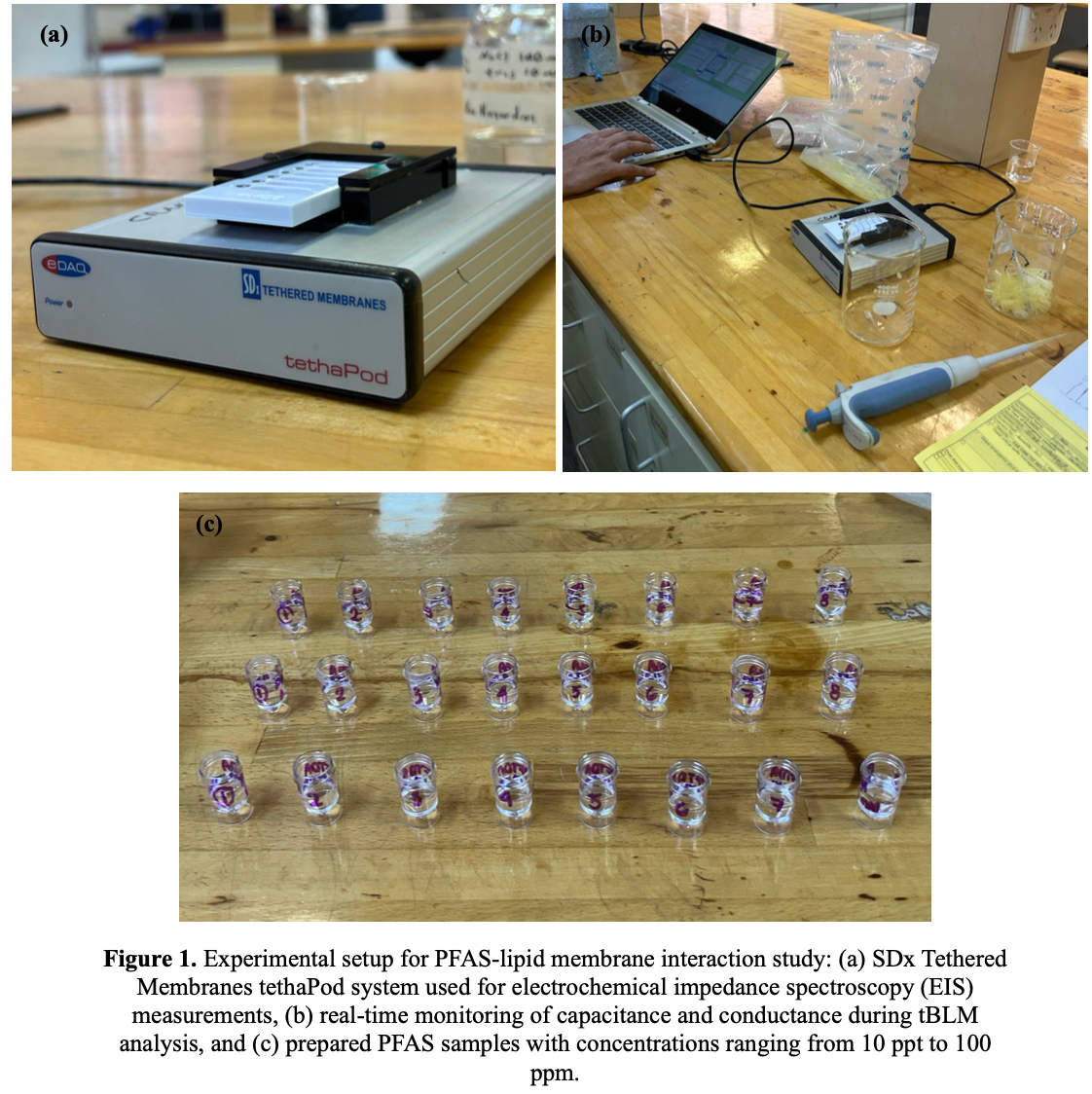


Evaluating the Detection Sensitivity of Electrochemical Impedance Spectroscopy Across Different PFAS Types Using Tethered Bilayer Lipid Membranes Per- and polyfluoroalkyl substances (PFAS) are long-lasting industrial chemicals detected in water systems worldwide and linked to serious health effects such as cancer and endocrine disruption. This project investigates how PFAS interact with cell-mimicking lipid membranes by measuring changes in their electrical behaviour using electrochemical impedance spectroscopy (EIS) and tethered bilayer lipid membrane (tBLM) systems. The study aims to identify how molecular structure, specifically chain length and functional group affects membrane disruption and to assess the capability of EIS-tBLM as a sensitive, real-time detection platform at micro to nanomolar concentrations. This approach offers a simpler and more immediate alternative to LC-MS/MS, the current laboratory standard that requires complex and costly sample preparation. Four PFAS types were tested (PFBA, PFOA, PFTeDA, and PFOS) across three tBLM architectures differing in tether–spacer ratio and gramicidin ion channel inclusion. Among these, PFOS, a sulfonic acid-based compound, produced the strongest and most consistent conductance increase, measurable at concentrations as low as 10 ppt. Carboxylic acid-based PFAS showed weaker and inconsistent responses, suggesting that their biological effects may occur through receptor-mediated pathways rather than direct membrane disruption, or that further refinement of the membrane model is required to capture these mechanisms. The research was conducted in collaboration with Dr. Bruce Cornell of Surgical Diagnostics Pty Ltd, with tBLM systems and EIS instrumentation provided through the support of Dr Charles Cranfield from the Membrane Biophysics Laboratory at the University of Technology Sydney. The study demonstrates the potential of the EIS-tBLM platform as a portable biosensing tool for PFAS detection and contributes to advancing sustainable, field-ready monitoring technologies that can strengthen environmental protection and public health management.


Cristine Nochefra