
I’m a final-year Mechatronics and Robotics Engineering student at Western Sydney University with a sub-major in Biomedical Engineering. My passion lies in using engineering innovation to improve healthcare outcomes. I recently completed a Biomedical Engineering internship at Royal Prince Alfred Hospital, where I worked hands-on with medical devices and 3D printing technologies. My final year project focuses on making patient-specific breast models to support cancer care, combining my technical background with a strong purpose to make healthcare more accessible, practical, and human-centred.

Reetika Karki

PROJECT OVERVIEW
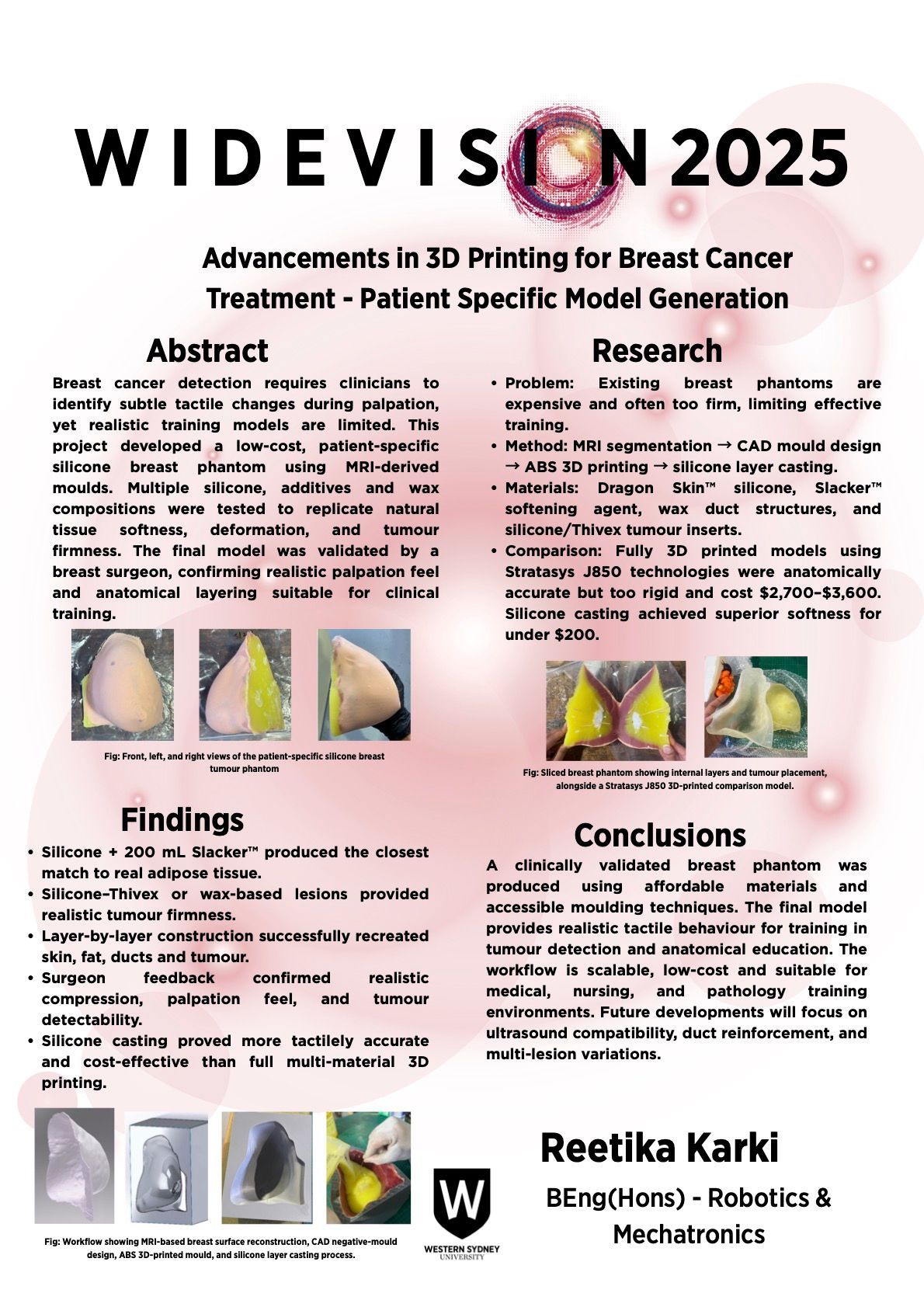


Breast cancer continues to be one of the most significant health challenges in Australia. According to national projections from Australian Institute of Health and Welfare, by 2026 there will be more than 22,000 new cases of breast cancer diagnosed annually across the country. It remains the most commonly diagnosed cancer in Australian women, with a lifetime risk of 1 in 7. Approximately nine Australians die from breast cancer every day, which equates to more than 3,300 deaths per year. Encouragingly, the 5-year relative survival rate is around 92%, but early detection, education, and hands-on clinical training remain critical in improving patient outcomes. This project responds to that need by developing a low-cost, patient-specific breast phantom that closely replicates both the appearance and the feel of real breast tissue. Using ultrasound or MRI data, 2D breast geometry is converted into a 3D model through 3D Slicer and SolidWorks. Instead of 3D printing the entire breast, only the mould is printed using Acrylonitrile Butadiene Styrene (ABS) material, reducing production cost and making the process scalable and accessible. Inside this mould, tailored silicone and wax layers are cast to mimic fatty, soft, and fibrous tissues. Realistic lesions are embedded, allowing users to practise palpation and tumour detection. Once completed, the model will support surgical rehearsal, student training, and patient education in a hands-on, practical way. What sets this project apart is its realism, reproducibility, and affordability. While commercial breast phantoms cost thousands of dollars, this workflow can be reproduced in a university or hospital lab at a fraction of the price. It is simple, teachable, and scalable. By combining biomedical engineering, material science, and clinical insight, this project contributes to more equitable breast cancer care and empowers future clinicians to make a real impact.


Reetika Karki