
XD-Volumetrix
XD-Volumetrix is a multidisciplinary student team working under the academic leadership of Dr. Amer Hijazi. Their project, Waranara Living, was proudly developed for the Autodesk Challenge Cup 2025, showcasing innovation in modular housing. Delivered through a full BIM workflow using Revit, Navisworks, Robot, Insight, and Forma, the design integrates digital twin technologies, DfMA strategies, 3D printing, and immersive VR walkthroughs. Prefabricated modules enhance efficiency and sustainability, while ground-level maker spaces and eateries foster inclusivity. Waranara Living redefines urban life as a platform blending smart technology, universal design, and real human stories to shape resilient, future-ready communities.

XD Volumetrix

PROJECT OVERVIEW
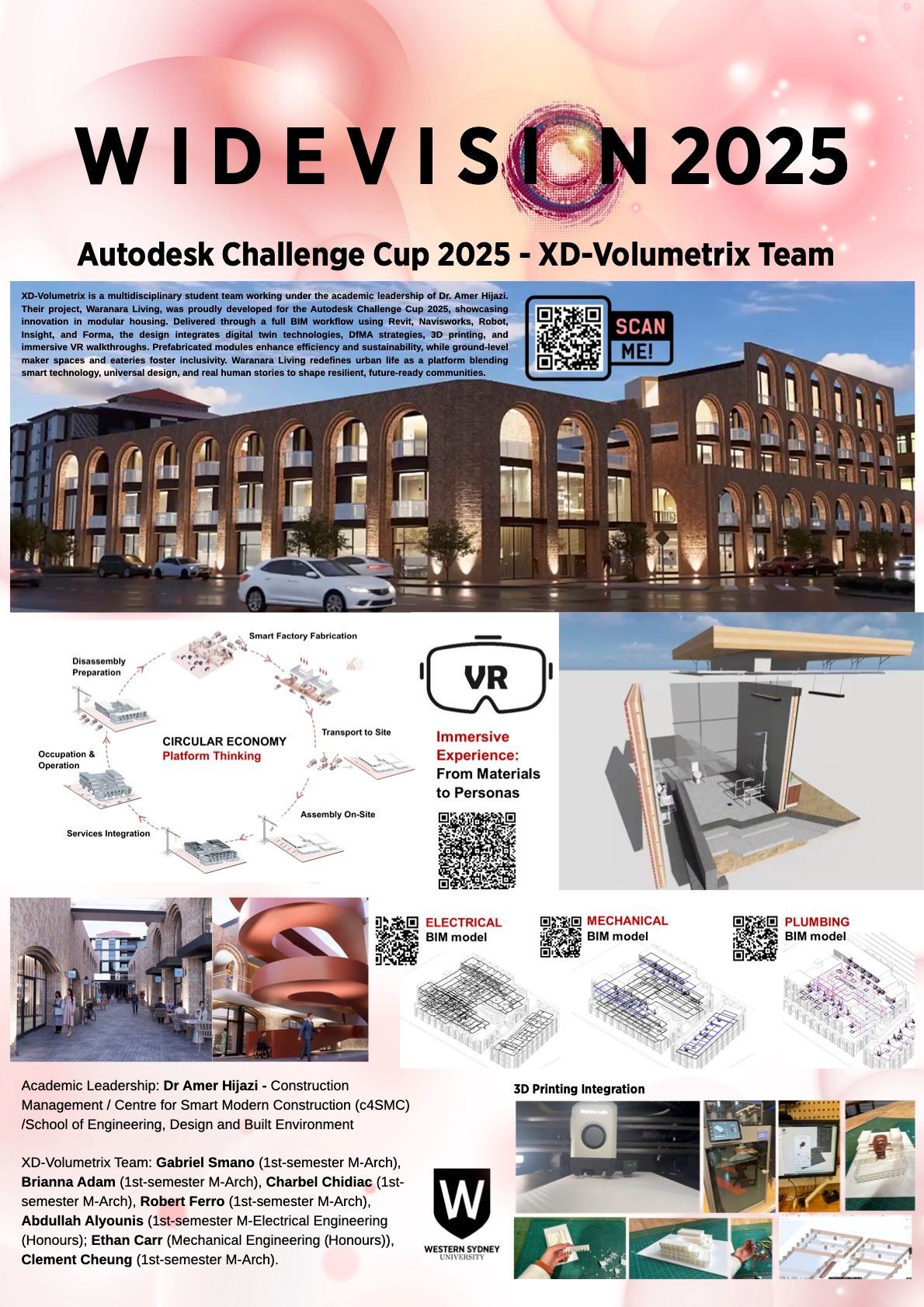


Waranara Living is a five-storey mixed-use development at 1–2 First Avenue, Blacktown, NSW, designed by the XD-Volumetrix team under the academic leadership of Dr. Amer Hijazi for the Autodesk Challenge Cup 2025. Rooted in the Aboriginal Darug word Waranara—“to seek” or “to explore”—the project reimagines modular housing as an inclusive, resilient, and human-centred platform for urban living. At its heart, the design embraces a story-driven, persona-led approach. Six personas—representing diverse abilities, cultures, and lifestyles—informed decisions ranging from circulation widths to sensory-calmed zones and even hygienic relief areas for assistance animals. This narrative methodology ensured the building responds to real needs, embedding dignity and independence into its spatial and technical solutions. The architecture is organised around a spiralling, accessible ramp—A Bridge Beyond Walls—that connects all five levels with seamless, step-free circulation. A sculpted central void channels daylight, ventilation, and visual connectivity, while ground-level maker spaces and eateries enliven the precinct. Digital inclusion is advanced through ARIA, a multilingual voice-activated assistant that ensures private, equitable access to smart building systems for all residents. Innovation extended to delivery methods. 3D printing provided tangible validation of circulation, modular interfaces, and assembly tolerances. A multidisciplinary collaboration of architects, engineers, and fabrication specialists leveraged a full Autodesk BIM workflow—Revit, Navisworks, Robot, Insight, and Forma—to coordinate prefabricated CLT panels, precast façades, and MEP pods within a DfMA strategy. Designed for 3.9-metre transport limits, these modules streamline logistics, minimise waste, and embed circular economy principles for future disassembly and reuse. Environmental performance is equally integral: rooftop solar arrays, drought-tolerant green roofs, and passive cooling strategies confirmed by digital simulations support net-zero ambitions. More than a building, Waranara Living is a replicable model for equitable, future-ready urban growth—where smart technology, universal design, and human stories converge.